
I stumbled upon this little treasure while exploring my friend’s Spotify playlist, and immediately knew that there was something special about it. Day 1 gave me a very snazzy, wobbly feel, and I found myself lurching bizarrely to each beat, probably to the amusement of my colleagues.
In this post we will be exploring the twin concepts of pushing and pulling, and how they combine to create the unstable, drunken feeling prominent in this song. Primarily a technique employed by jazz musicians, I never thought I would find rhythmic pushing and pulling in modern songs, but I guess I was wrong. Without further ado, let’s begin!
The song starts out sneakily – just vox accompanied by piano comping (comping = accompaniment for short) and a single minim ‘clap’ to keep time. I must say I love the chord progression of GbM7 – Gbm6 – Bbm7 – Db7/F, because it’s not as happy as what you would imagine from Gb Major (Chord progression is: I – i6 – iii – V7). With good reason i suppose – this song has a rather mysterious and unstable feel to it, which we shall discuss in time to come.
Verse 1B is slightly different from verse 1A. The comping moves to a lower register and Honne introduces this lovely sparkling riff at 0:33 which we will hear a lot of throughout the song. I really love the use of the fuzzy, slightly out of tune piano – very reminiscent of 1950s recordings (listen to the piano in the background of this 1950s classic).
The comping pattern is actually fairly straightforward – a 3,3,2 rhythmic pattern that’s quite commonly found in pop music these days. The best parallel I can think of is Ed Sheeran’s Shape of You – listen to the xylophone/marimba riff and you can tell that the very same rhythmic pattern underpins both Shape of You and Day 1. Yet both songs have very remarkably different feels to them, and we’ll come back to this towards the end of the post.
The drums come in at the pre-chorus (“Everybody wants to love”) to prepare listeners for the enveloping chaos that is to come. Almost immediately, I could sense that something was off. This was no typical dance track – there was something special about the beats. In fact, I couldn’t put my finger on it until I decided to write this blog and was forced to do some research. So after a bit of trial and error, I set my metronome to 100BPM and played the song over it. What happens next will shock you.
I discovered that Honne indeed had misplaced the bass kicks to throw listeners slightly off. If you listen carefully, (might need to slow the song down) the bass kicks are always positioned just a fraction in front of the beat. Now this part is going to be slightly technical and potentially confusing, so for the sake of clarity I shall revise some basic theory about rhythm. (Skip the following section if you’re familiar with music fundamentals…)
* MUSIC THEORY INTERJECTION *
Most music is built on top of what we call a “pulse”, which like its biological cousin is just a steady beat. The pulse/beat can be fast or slow, and is measured in Beats Per Minute (BPM). However, “Popular” (if such a term can be used to describe music throughout the ages) music did not always stick to a regular pulse. Romantic and 20th-century Classical music are known for having very fluid pulses – also known as rubato – and there is certainly beauty in that too. However, by and large, most music of the late 20th century and 21st century does not employ a variable pulse, and I daresay it’s because we have shifted to a very dance-centric music culture where an unwavering pulse is favoured. Thus it is important for a modern musician to be able to maintain a steady pulse/tempo without speeding up or slowing down.

Apart from maintaining the right tempo, there’s also the secondary issue of playing on time once you have established a regular tempo. Just as how an instrumentalist/vocalist tries as far as possible to sing/play in tune, ie hitting all the right notes pitch-wise, the drummer’s job is to hit the right notes at the right time.
But humans aren’t perfect, and there’s an article that argues that imperfect drumming patterns actually make music sound more human. You can read about it here, but that’s not what I’m concerned with in this post. To make their recordings more regular and ‘perfect’, musicians and producers employ ‘quantizers’ in recording software that automatically shifts all beats to their rightful place. Any imperfections that may arise during the recording process can be simply Thanos-ed away with a single click.
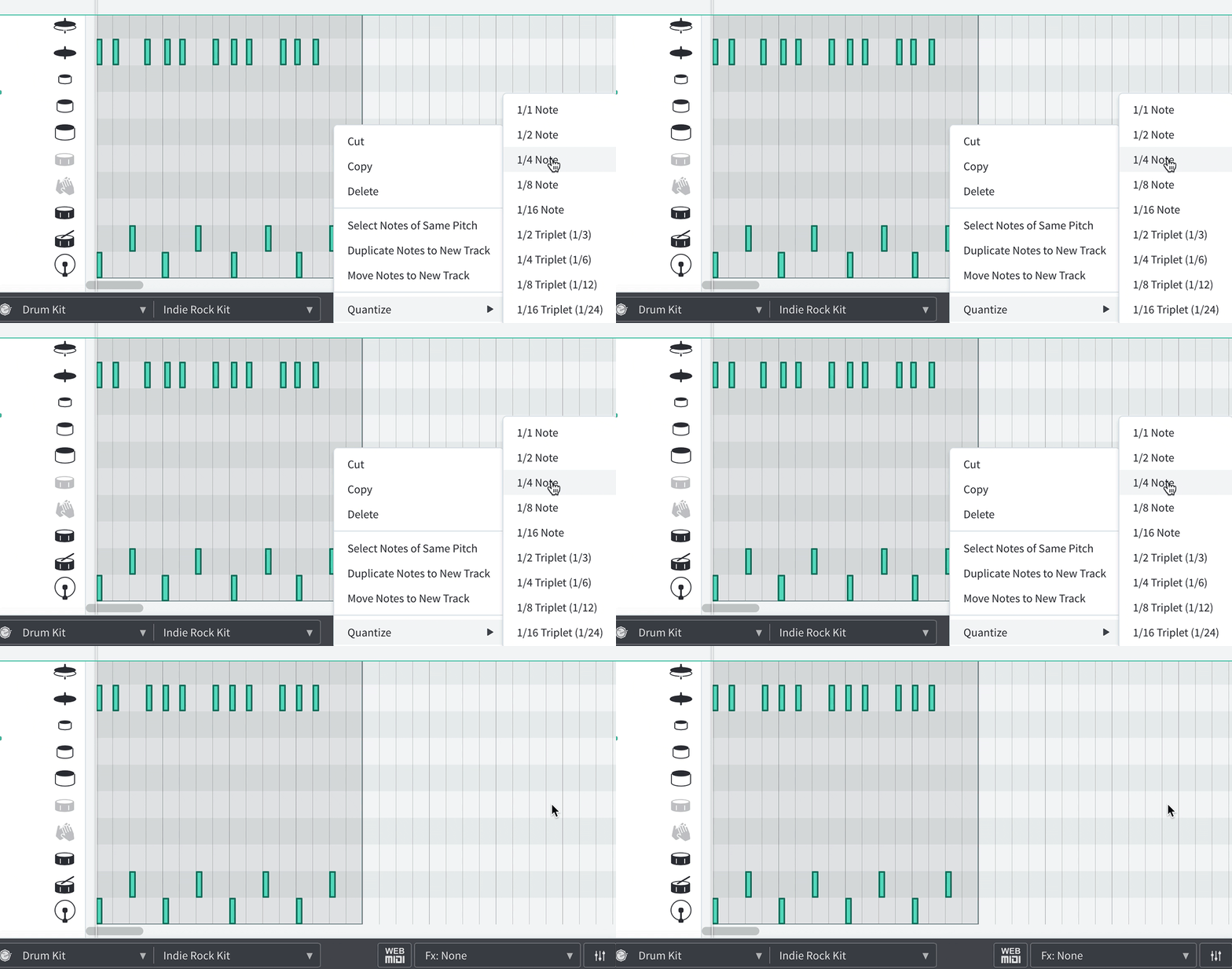
As a result, most pop/edm music is very rhythmically ‘perfect’. We tend to have:
- 1. unwavering pulses/tempo, with
- 2. rhythmic accuracy – bass kicks on every beat and snare drum and high hat strikes on every binary sub-division of a pulse (ie. every 1/2, 1/4, 1/8… beat)
largely, I reckon, because we need such regularity to jump and rave to. That should be enough context for now, back to the song in question.
*** END OF INTERJECTION ***
Day 1 is a mid-tempo song of 100 Beats per minute, employing a 4-beat grouping. Nothing out of the ordinary thus far, except that it might be a little bit slow for raving. However, what really jumps out at me is its deliberate rhythmic inaccuracy. NOTE! The pulse itself is steady (the 100bpm is maintained throughout the song), but Honne does not place all of the drum hits on the beat. As mentioned above, the bass kicks (and also the snare hits) always come in a fraction of a millisecond early, throwing listeners just slightly off. I daresay Honne quantized these parts first, THEN shifted them slightly forward, thus creating this artificial imperfection that is SO RIDICULOUSLY TASTY. The Jazz world calls it “pushing” the beat, ie. playing before the beat arrives. It creates a feeling of urgency, since you seem to be artificially rushing the music.
When the music transitions to the chorus, you hear this “wub wub wub(?)” instrument (around 1:00) that’s playing the same notes as “You’ll always be my Day 1…”, only it seems to be echoing the singer and coming in after the main beats. This is the anti-thesis of the ever-early bass kicks. The riff is being played a fraction of a second later, rather than earlier, creating a feeling of laissez-faire chillness (in Singaporean vernacular, Lepak). Jazz theory calls this “pulling” the beat, invoking a yawning feeling that seems to slow the music down. The singer himself does this every time he sings “nothing by myself” or “day zero when i was no one”.
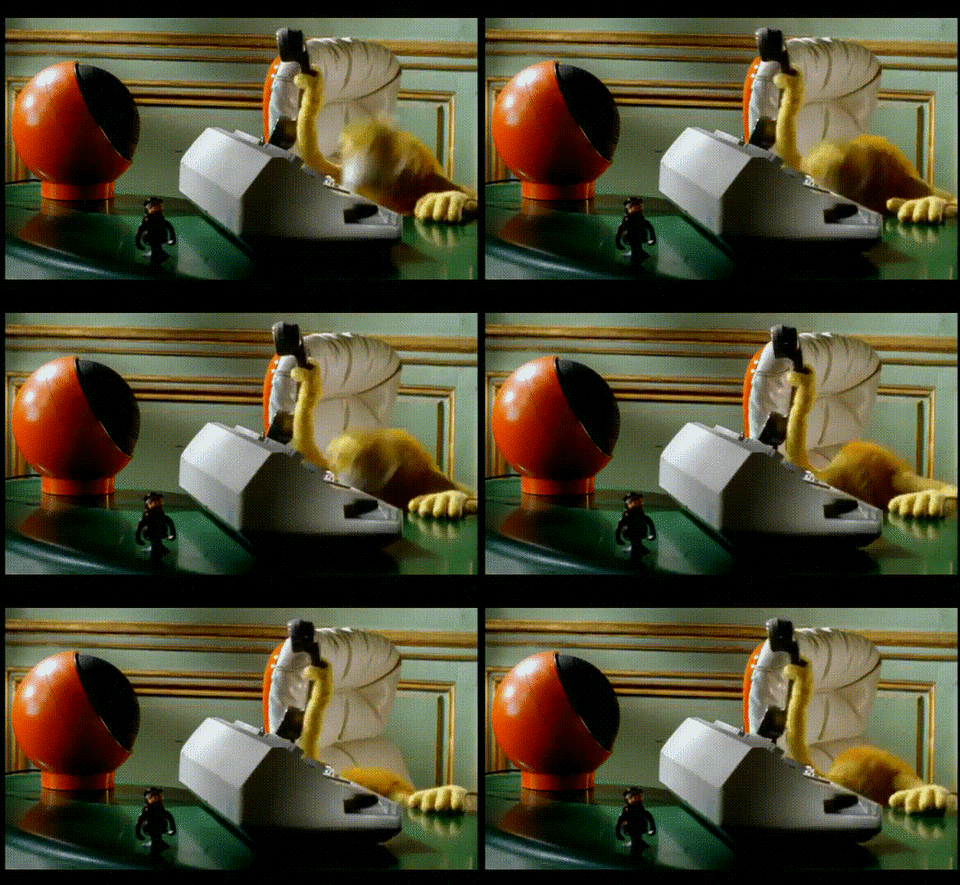
Joining both parts together, you get what I can only describe as beautiful chaos. Half the band is driving the music forward while the other half is holding it back. You get the sense of an irregularly shaped automaton that’s lurching forward, limping from side to side, yet still moving steadily along. Something like this:
“But why does this sloppiness still sound so good?”, you may ask. I think it is because the tempo/pulse of the song is still steady and unwavering, so it doesn’t feel like a display of amateurism, but rather a deliberate flaunting of one’s technical prowess – being able to dance around the beat because you’re so familiar with where each beat is in time and space. The juxtaposition of rhythmic pushing and pulling within the same time frame paints an image of a massive party where everyone is doing their own thing – some are playing cards, some are napping, some are dancing – yet all are enjoying themselves and making the party lively and vibrant. I love this feeling of chaos amongst order. It’s like salted caramel. Why is there salt on my ice cream? Who came up with this stup- oh hey it’s kinda nice. Hmm.
When the music moves to verse 2, we find that the comping is now being performed by a Rhodes electric piano rather than the oldie acoustic piano. This EP has even more fuzz and pitch-ambiguity than the acoustic piano, further adding to the mysterious and lazy feel of the song. To top it off, Honne now adds a new high-pitched melodic riff (Db F Bb, Db F A, Db F Ab) and I am in LOVE with this riff because it’s barely in tune. I’m pretty sure it hits quarter-tones or something. All of this complements the singer’s “I’m great and I don’t need to exert myself to prove my skills” way of singing, creating a nice ‘low’ before the highs of the next chorus.
Nothing much gets added to the second chorus, but I like the way it transitions to the bridge almost immediately. Many artists these days kill the momentum from their own hooks by dying down abruptly into a bridge which possesses neither lyrical meaning nor musical sense. Such bridges are so awfully formulaic and unnecessary, Bleh! Day 1’s bridge serves as an extension to the chorus, with some tasty chord changes to spice things up a little. I really like how he ends with “I just want you to knooooow”, accompanied by that twinkling, descending waterfall, before returning to the start of the song, the “Day 1” (Hoho!).
The chorus repeats once more to give us a final taste of that delicious anarchy. The wub wub instrument really goes ham here, playing lines that bleed into other beats and bars, totally ignoring the scoresheet that his band leader meticulously wrote out for him. I really like the choral accompaniment at the back too, like a bunch of onlookers who want in on the party, smiling at the drunken partygoers and the celebrations before them.
To wrap things up, we now have a pretty good idea why this song sounds so different from Ed Sheeran’s Shape of You despite employing the same rhythmic motif. While Shape of You enforces military-grade rhythmic accuracy, Day 1 prefers to let the instruments do their own thing, provided they respect the underlying pulse. A friend of mine (shoutout to Bryan Joel Lim) told me that Day 1 belongs to a genre of music called “Wonky”. Can you find a better description of a song? I think not! And yet, in all of its (artificially constructed) imperfection, I find great joy, exuberance and a slight headache from too much head-lurching.
05/27/2019
 E-DayuM